Apple Ads — 8 May 2026
How to win the Apple Ads’ additional placement? The Share of Voice data SplitMetrics calculates for you and other tools don’t.
 SplitMetrics
 SplitMetrics

Apple Ads added an additional ad placement to the App Store search results in March 2026. With both placements in place, a typical search result now shows an Apple Ads result at the top, followed by an organic result, and then an Apple Ads additional placement result.
The widely used metric among enterprise teams that helps to understand these changed market conditions is Share of Voice (SOV). SplitMetrics is now the first Apple Ads partner to use industry gathered data and calculate Share of Voice for the new placement separately.
Apple Ads analytics provides an Impression Share, a useful signal that tells you a range of eligible impressions you captured on a keyword. SplitMetrics Acquire expands that level of insights with additional inferred data, to calculate Share of Voice as an exact number per keyword.
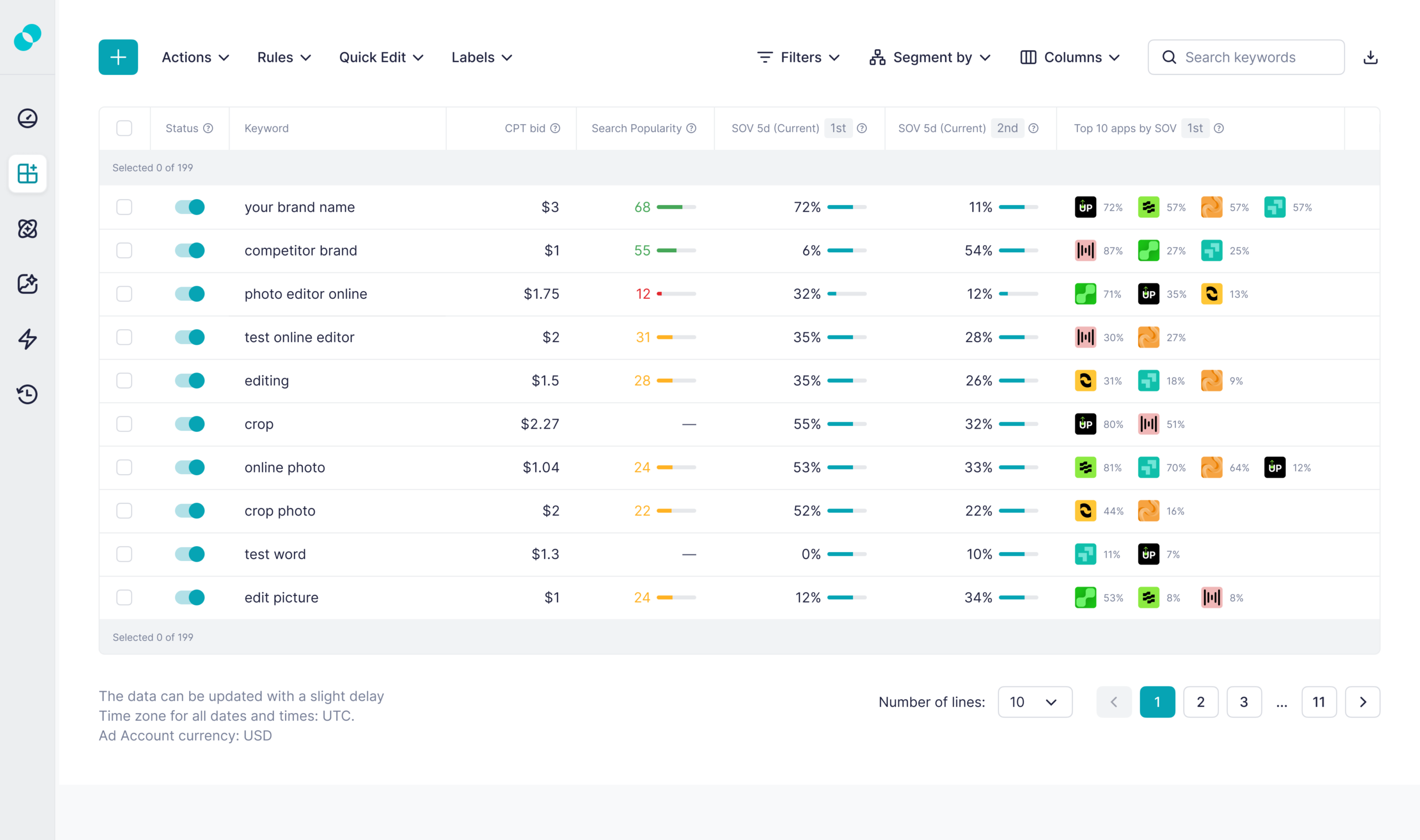
Based on SplitMetrics 11 years of experience working with category leading apps, enterprise marketing teams tend to not focus on winning impressions. They’re target is to win purchases, first-time deposits, subscriptions, and ROAS. Share of Voice is the metric that supports all of them, because it is measured per keyword on the same terms your bids are placed.
So when you measure SOV alongside down-funnel outcomes, you can analyse your campaigns in the following ways:
With the additional placement, the opportunity to win on every keyword increased. Succeeding in this new environment depends on using the Share of Voice metric at a next level of precision. That is where SplitMetrics has spent years building capabilities other platforms in the market do not offer in the same depth.
The Impression Share is an Apple Ads metric reported in ranges by most of the campaign management tools.
What SplitMetrics Acquire adds on top, is the market intelligence layer. That is, marketers can see Impression Share within SplitMetrics Acquire as well as SOV for Apple Ads placements as SplitMetrics Acquire now calculates both. SOV for the additional placement uses inferred data to help give marketers more granular and actionable insights. Other Apple Ads campaign management tools currently report SOV for the top placement only.
Here is how the three layers stack up in the tools enterprise Apple Ads teams most often evaluate.
| Data | Apple Ads Native Dashboard | Other Apple Ads campaign management tools | SplitMetrics Acquire |
| Impression Share (reported as ranges) | Yes | Yes | Yes |
| Share of Voice, exact value per keyword | – | Yes | Yes |
| Share of Voice split by placements (competitors share, icons and links gaining keyword impressions) | – | – | Yes |
| Share of Voice refreshed every six hours on a 24-hour window | – | – | Yes |
| Coverage across Search tab and Today tab | – | Partial | Yes |
That layer delivers on three fronts:
SplitMetrics Share of Voice metric variations answer three questions:
Five plays turn those answers into action, each running on a capability inside SplitMetrics Acquire to help you optimize Apple Ads campaigns.
Brand defense is used to protect your brand keywords. A competitor can now sit at the additional placement on your brand term while your top-placement numbers still look healthy.
With SplitMetrics Acquire SOV, you can quickly spot this situation — and see exactly who holds each placement through Top apps 1st and Top apps 2nd.
Portfolio domination is used when your publisher account holds more than one app, and the play is to bid the same keyword from two of your apps so you can take both ad placements at once.
With SplitMetrics Acquire SOV, you can easily see when your portfolio owns both placements and when a competitor has taken share from one of them.
Competitor offense play is helpful when different competitors are winning ad placements on a keyword where you also rank high organically.
With SplitMetrics Acquire SOV, you can notice this pattern early to reclaim the paid position.
Competitor keyword discovery is used to find the keywords your competitors are capturing share on but you are not yet bidding on.
SplitMetrics Acquire surfaces the competitor’s active keyword set with SOV, keyword by keyword, and turns those signals automatically into campaign additions.
Share of Voice gets more actionable when combined with automations. Automation rules turn the SOV signal into bid moves that execute on their own, accepting SOV as a condition at the keyword, ad group, and campaign level. Two rule templates cover what enterprise teams set up first.
Brand defense rule defends your brand keyword automatically. When SOV on a brand keyword drops below the threshold you set, the rule raises the cost-per-tap (CPT) bid by a fixed percentage, sends a Slack notification, and caps the increase at a bid ceiling you define.
The threshold is subjective, and the range most enterprise teams target on brand keywords is 80% to 90%, with 90% as the strongest defense posture.
The overbidding cap rule caps your bid on keywords you already dominate. When SOV on a generic keyword is above 90% and ROAS is above your target, the rule holds the bid flat.
In our experience, with 90% SOV share, raising the bid does not anymore add more impressions but you still pay the difference on every impression you would have won anyway.
Based on what we’ve observed across SplitMetrics-managed accounts, the apps that consistently win across both Apple Ads placements tend to be the ones whose creative aligns most closely with the keywords and user intent on the query. Custom product pages are the most direct way to tighten that alignment.
Custom product page variants move the numbers that matter. Across SplitMetrics Acquire accounts, custom product page-based ad variations lift tap-through rate by roughly 9% on average, and up to 27% in search results campaigns.
As an example, one of our clients saw from custom product pages refresh in a single iteration:
A common problem for many apps is identifying which custom product pages work the best – which is why testing custom product pages is the right tactic.
CPP Experiments Hub is the SplitMetrics Acquire feature for testing custom product page variants. It runs tests and tells you which variant performs best – with enough confidence to act on the result, not guess. Results connect to your post-install metrics through your MMP, so you see how creative variants impact downstream performance, not just clicks.
Why does this matter alongside SOV? SOV per placement shows where competitors are positioned alongside you. Custom product page testing shows which creative wins that impression back.
If your bid and budget are already high but share isn’t growing, the bottleneck is likely relevance – not auction position. That’s where custom product page testing pays off.
How often is the SplitMetrics Acquire Share of Voice metric updated?
The 5-day view refreshes daily. The 24-hour view refreshes every six hours, four updates a day.
Do I need to set up anything new in my account to see the Share of Voice metric?
No. Every campaign and eligible keyword already running in SplitMetrics Acquire is covered automatically. The new SOV column appears in the Keywords and Search Terms dashboards with no toggle, no campaign rebuild, and no data backfill to wait on.
When should I use SplitMetrics Acquire SOV 5-day versus SOV 24-hour?
The 5-day view is the right cadence for weekly bid reviews, brand defense monitoring, and keyword pruning. The 24-hour view is built for volatile categories where market shifts move your CPA in the same day. If your campaigns are stable, the 5-day view is enough.
Does SOV cover the Search tab and Today tab?
SplitMetrics Acquire SOV is designed around search results. The same competitive visibility layer covers the Search tab and Today tab as well, with 30-day rolling averages.
How does this interact with SplitMetrics Acquire’s AI Bid Optimization?
Our AI Bid Optimization already uses SOV as one of its internal signals. For teams using AI across the account, the additional data columns are the transparency layer on top of that.
If you want to see what SplitMetrics’ Acquire Share of Voice metric looks like for your specific app without having an account, then book a 20-minute walkthrough and we’ll show you what your competition is doing.
Disclaimer: As Apple Ads does not currently provide separate Share of Voice (SOV) reporting for this additional placement, the insights presented in this article are calculated and based on independent third-party market intelligence derived from aggregated and publicly observable App Store activity. These insights are intended to provide directional visibility into competitive dynamics and support advertiser decision-making in areas where native reporting is not yet available.