







SumUp is a leading global fintech company committed to leveling the playing field for small businesses. Founded in 2012, SumUp is the trusted partner of over 4 million merchants in 37 markets, providing simple and affordable tools that help them manage payments, finance and customer relationships.
Challenge
SumUp set out to scale user acquisition across 11 European markets, spanning six Core Tier 1 countries — the UK, France, Germany, Italy, Spain, and the Netherlands — alongside five supporting Tier 2 markets.
During the first quarter of 2025, SumUp’s acquisition strategy mostly relied on high-intent search channels. TikTok iOS and Meta iOS campaigns were still in the early testing phase, focused on validating audiences rather than scaling efficiently. As a result, paid social channels delivered higher CPAs than the more established search campaigns.
The team was looking to overcome the following challenges:
- Scale acquisition significantly across multiple European markets.
- Keeping acquisition costs efficient as investment increased.
The biggest challenge was scaling acquisition without compromising sign-up quality or efficiency. We rebuilt the paid social setup around downstream conversion events, standardized attribution, continuously reallocated budgets, and expanded the channel mix as the account matured. Combined with systematic creative testing across hundreds of assets, this helped us increase investment by 409.6% and sign-ups by 388.8%, while keeping blended sign-up CPA almost flat.

To achieve this, SumUp turned to the SplitMetrics Growth Services. Our experts started managing the app’s paid social channels in April 2025, with a focus on improving measurement, optimization and driving higher-quality sign-ups.
Solution
Attribution Standardization (April 2025)
For our team, the first step was to make sure all paid social platforms were tracking conversions in the same way. This gave the platforms clearer and more consistent signals to optimize campaigns. As a result, monthly sign-ups grew by 26.7%, while blended CPA fell by 7.3% compared to the previous month.
Algorithmic Maturation (May 2025)
Once the new attribution framework was in place, campaign optimization shifted from install-based bidding to downstream sign-up events. This enabled platform algorithms to optimize for higher-quality users rather than installs alone. During this period, TikTok’s CPA dropped by 40.6% month over month, helping reduce the portfolio’s blended sign-up CPA by 18.5%.
High-Level Growth Dynamics
The table below summarizes performance growth between the baseline period (January 2025) and the campaign’s peak scaling period (May 2026).
| Performance Metric | Growth | Business Impact |
| Monthly Marketing Investment | +409.6% | Marketing investment increased steadily to support expansion across all target markets. |
| Monthly App Installs | +297.2% | Top-of-funnel acquisition scaled significantly across Europe. |
| Monthly Sign-Ups | +388.8% | Sign-up growth closely matched the increase in marketing investment, reflecting strong downstream performance. |
| Blended Cost per Sign-Up (CPA) | +4.3% | Acquisition costs remained remarkably stable despite a fourfold increase in marketing investment. |
Month-over-Month Performance
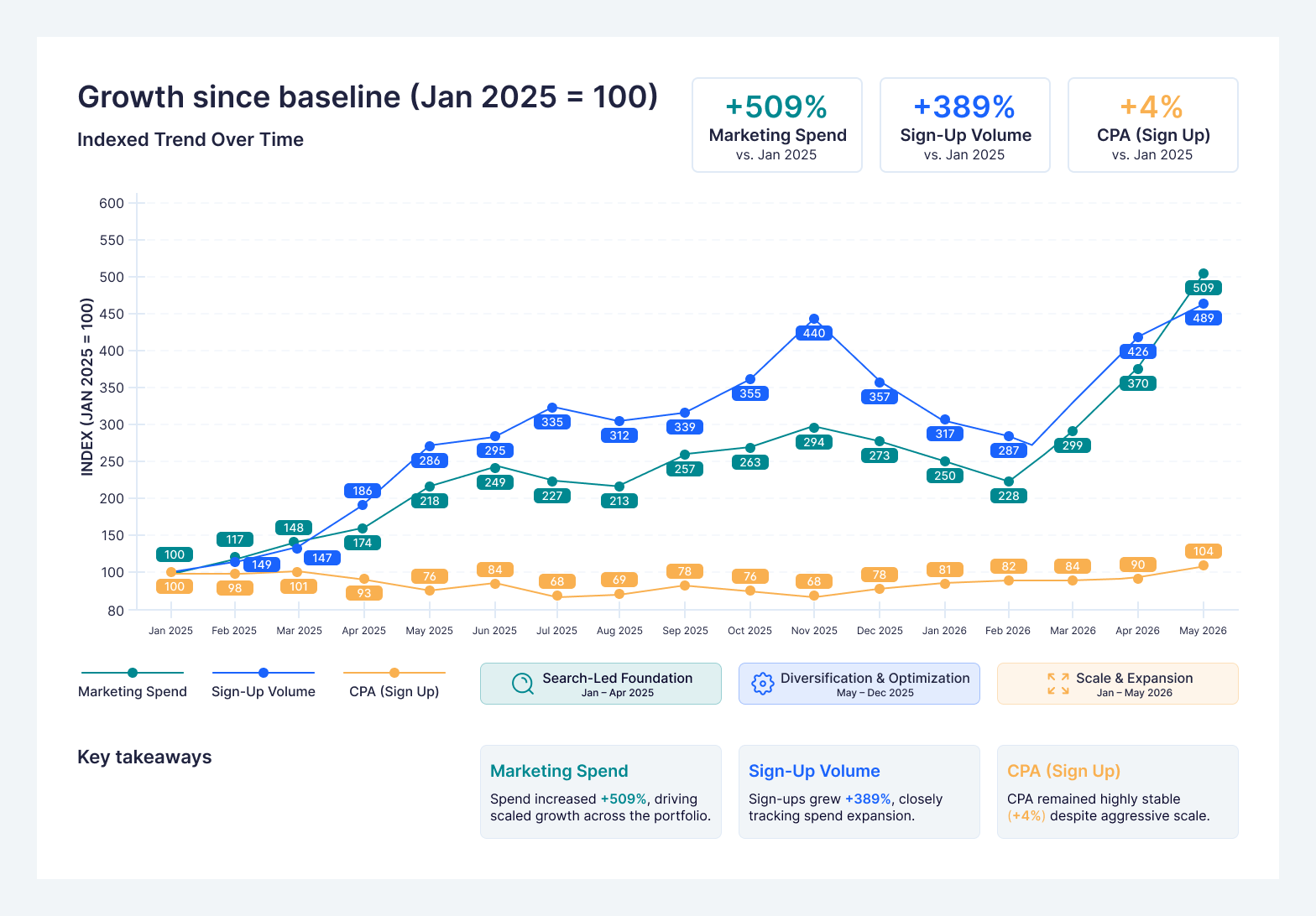
After the initial account transition, we developed the strategy through several key phases. In early 2025, our experts focused on better measurement and shifted optimization from installs to real sign-ups. This approach led to a significant improvement in acquisition efficiency.
In the second half of 2025, we focused on controlled scale and channel diversification. We adjusted budgets based on performance and seasonal demand and expanded the channel mix. After the seasonal slowdown in December and early 2026, we gradually increased investment again.
March-May 2026 marked our strongest scale-up phase. By May 2026, investment was 409.6% higher than the January 2025 baseline and sign-ups were 388.8% higher, while blended CPA increased by only 3.7%.
Funnel Conversion Efficiency
One of the strongest outcomes of our strategy was improving user quality while increasing acquisition volume at the same time.
At the beginning of the campaign in January 2025, the blended install-to-sign-up conversion rate stood at 15.5%. By May 2026, following the introduction of downstream conversion optimization across the media mix, the conversion rate had increased to 19.1%.
The higher conversion rate shows that growth came not only from increased media investment, but also from bringing in users who were more likely to complete registration.
Media Mix Evolution & Strategic Roadmap
The timeline below shows how we built and evolved SumUp’s acquisition strategy: from a search-led setup to a diversified, multi-channel portfolio.
October 2024 | Campaigns Launch
Campaigns across Apple Ads and Google Universal App Campaigns were launched for both iOS and Android. These channels created the foundation for SumUp’s acquisition strategy.
February 2025 | Search Portfolio Refinement
Google iOS campaigns were stopped due to higher acquisition costs and measurement limitations. Google Android and Apple Ads remained the core search channels and continued to drive scalable acquisition.
Late April 2025 | Paid Social Transition
Our team took over Meta iOS and TikTok iOS. We restructured the campaigns around downstream sign-up events instead of installs, giving the platforms a much stronger signal for optimization.
November 2025 | Programmatic Expansion
We introduced a Moloco iOS campaign to diversify acquisition and reach users beyond traditional search and social channels.
May 2026 | Portfolio Expansion
Snapchat iOS was added to broaden audience reach and support incremental growth during the campaign’s peak scaling period.
Channel strategy
The table below summarizes the strategic role each acquisition channel played throughout the engagement.
| Platform | Status | Primary Role |
| Apple Ads (iOS) | Continuous management | Primary efficiency channel, delivering the lowest acquisition costs while maintaining overall portfolio efficiency. |
| Google Android | Continuous management | Primary volume driver, supporting scalable user acquisition across all target markets. |
| Google iOS | Discontinued (Feb 2025) | Removed due to higher acquisition costs and measurement limitations. |
| Meta iOS & TikTok iOS | SplitMetrics takeover (Apr 2025) | Transitioned from early testing campaigns to scalable acquisition channels optimized around downstream sign-up events. |
| Moloco iOS | Introduced (Nov 2025) | Expanded programmatic reach and diversified acquisition beyond traditional search and social channels. |
| Snapchat iOS | Introduced (May 2026) | Added to broaden audience reach and support incremental growth during the final scaling phase. |
Search as the Portfolio Foundation
Google Android and Apple Ads formed the core of the acquisition strategy. Google Android acted as the primary volume driver, while Apple Ads consistently delivered the lowest acquisition costs.
During the May 2026 scaling phase, Google Android increased spend by 31.7% month over month while maintaining strong acquisition volume. Apple Ads increased monthly sign-ups by 25.3% while reducing CPA by 10.4%.
Paid Social as a Driver of Incremental Growth
TikTok, Meta, and later Snapchat helped expand acquisition beyond existing search demand through continuous optimization, creative iteration, and audience expansion.
Creative Testing at Scale
A key part of the growth strategy was a structured and diverse creative testing approach. We continuously tested UGC content provided by the client’s team, static assets produced both by the client and by our team, as well as animated creatives. This allowed us to explore different creative angles, formats and messaging across markets and channels, while identifying opportunities to improve performance.
Through testing hundreds of creatives, we detected a number of concepts that consistently stood out as top performers. Below are some examples of the strongest creative concepts uncovered through this testing process:
Strong & Relatable Creative Hooks
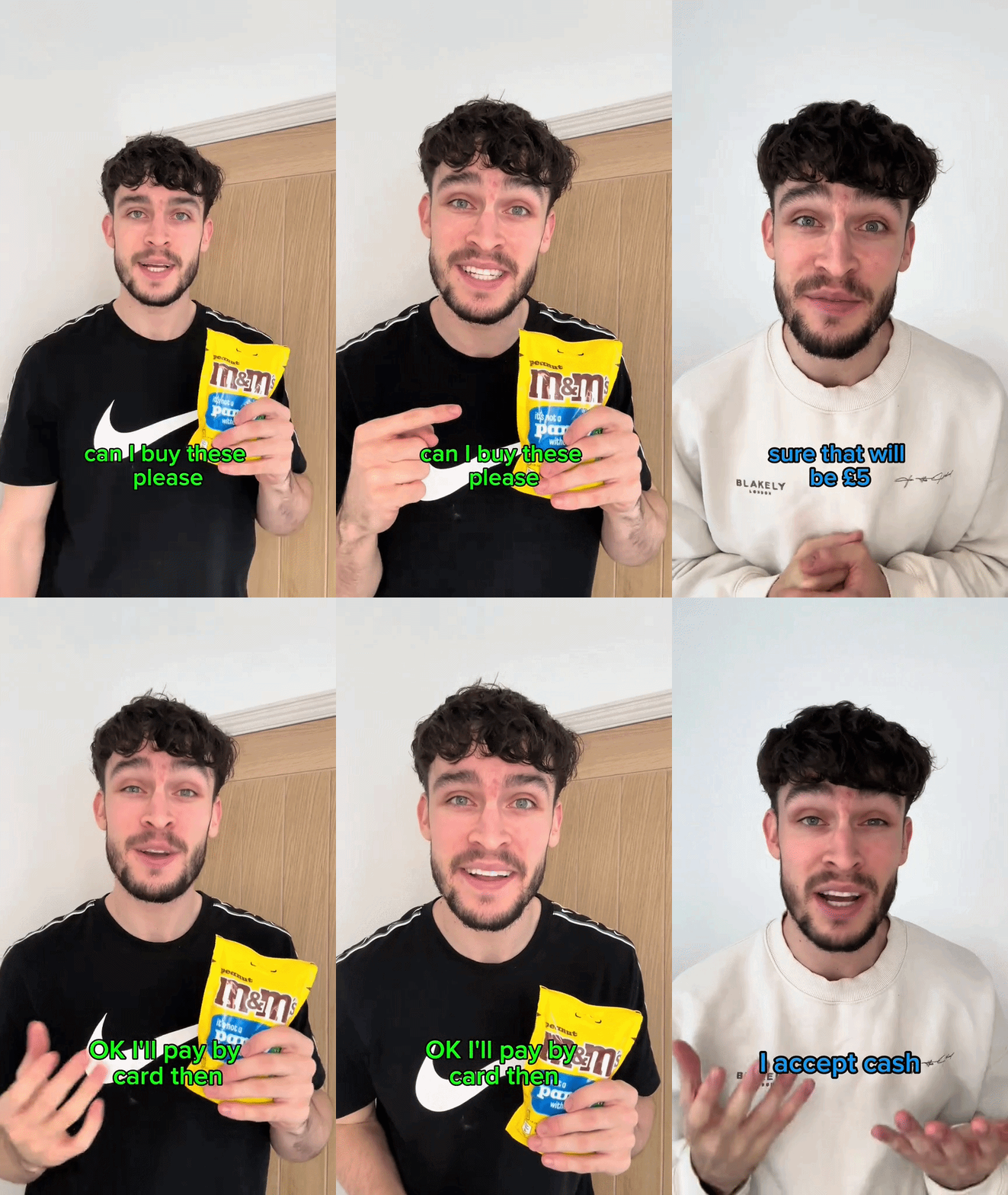

Testing relatable pain points and attention-grabbing hooks that quickly connected with the target audience.
UGC Trends
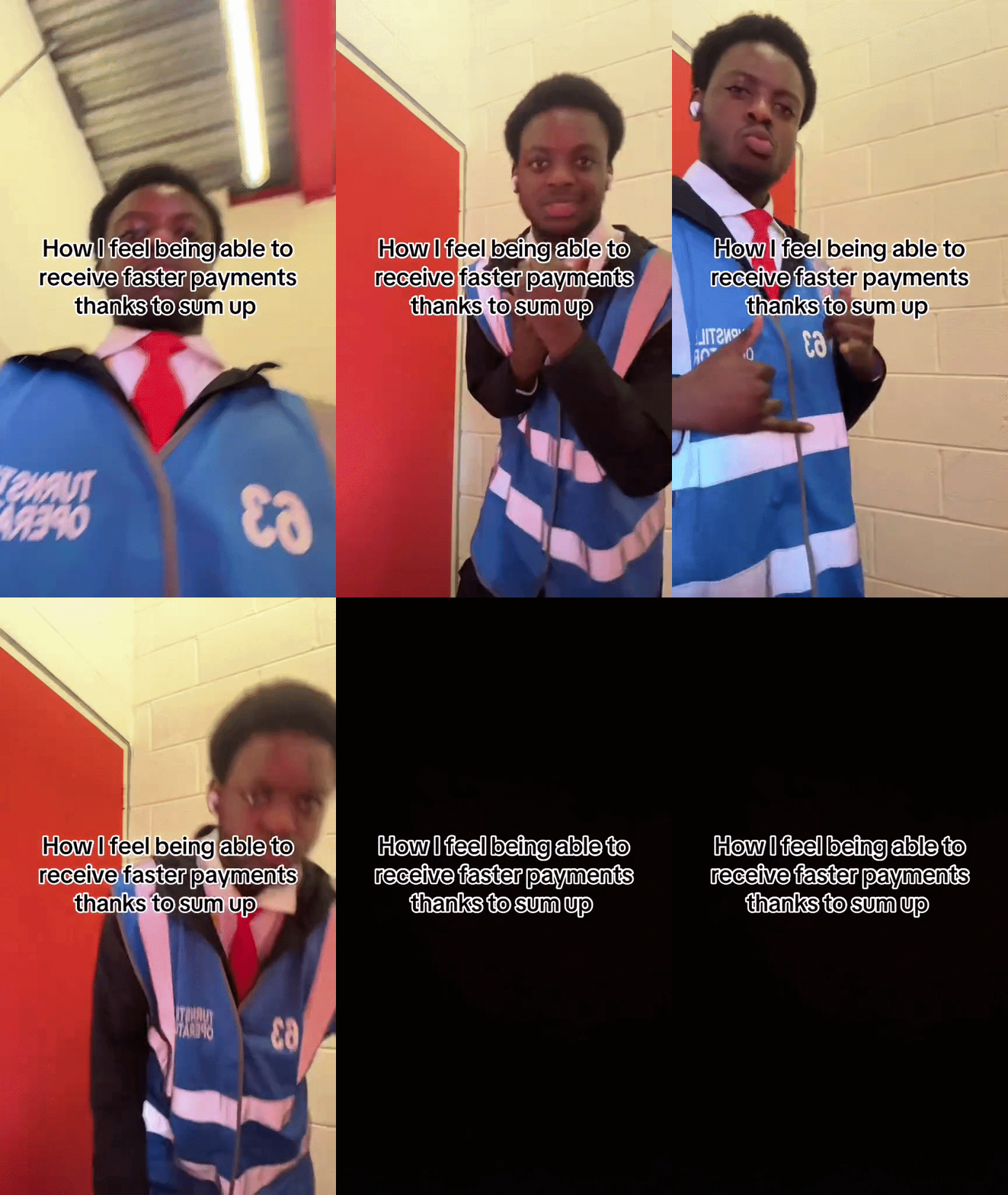
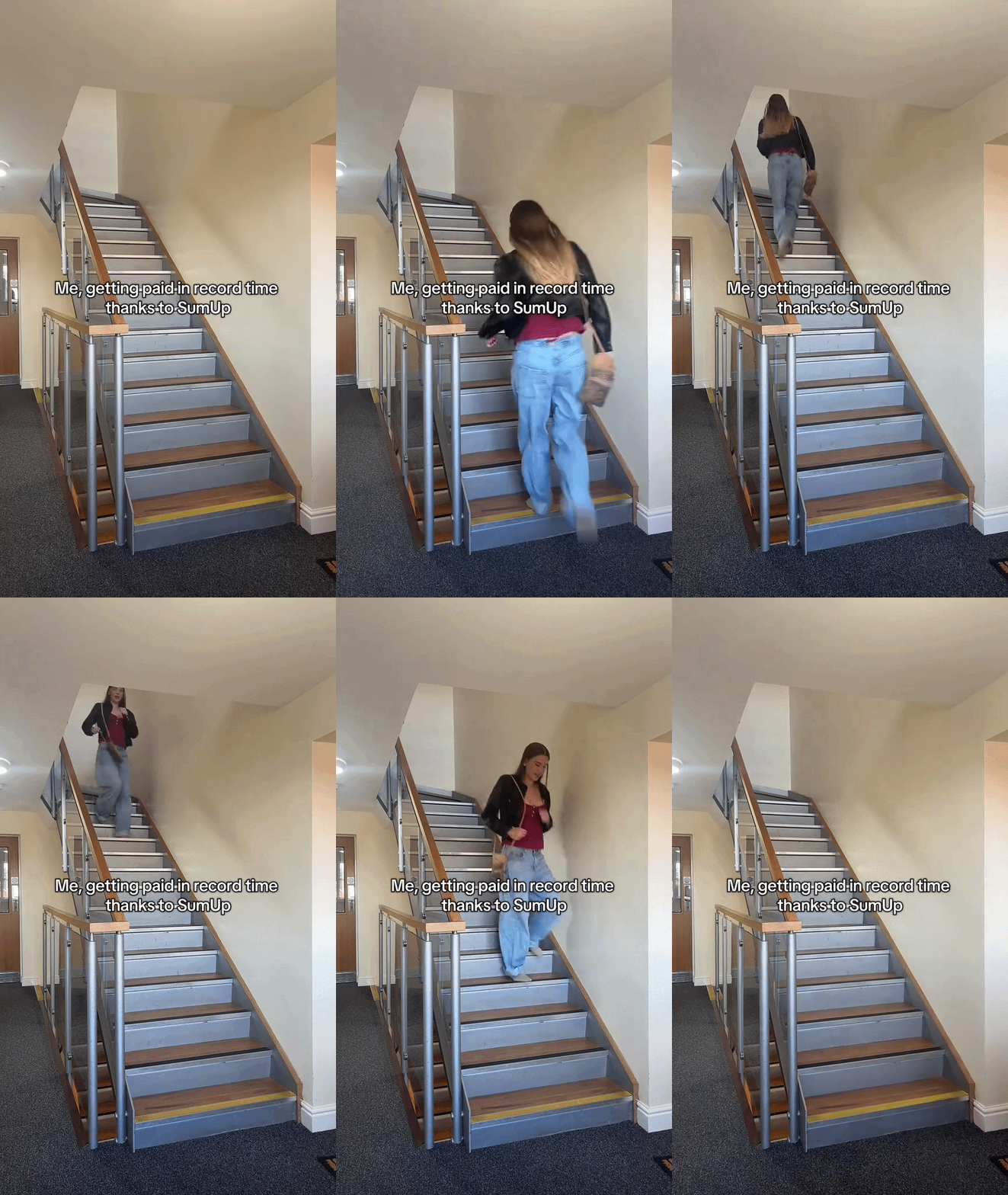
Leveraging trending UGC formats and native social content styles to make the ads feel authentic and engaging.
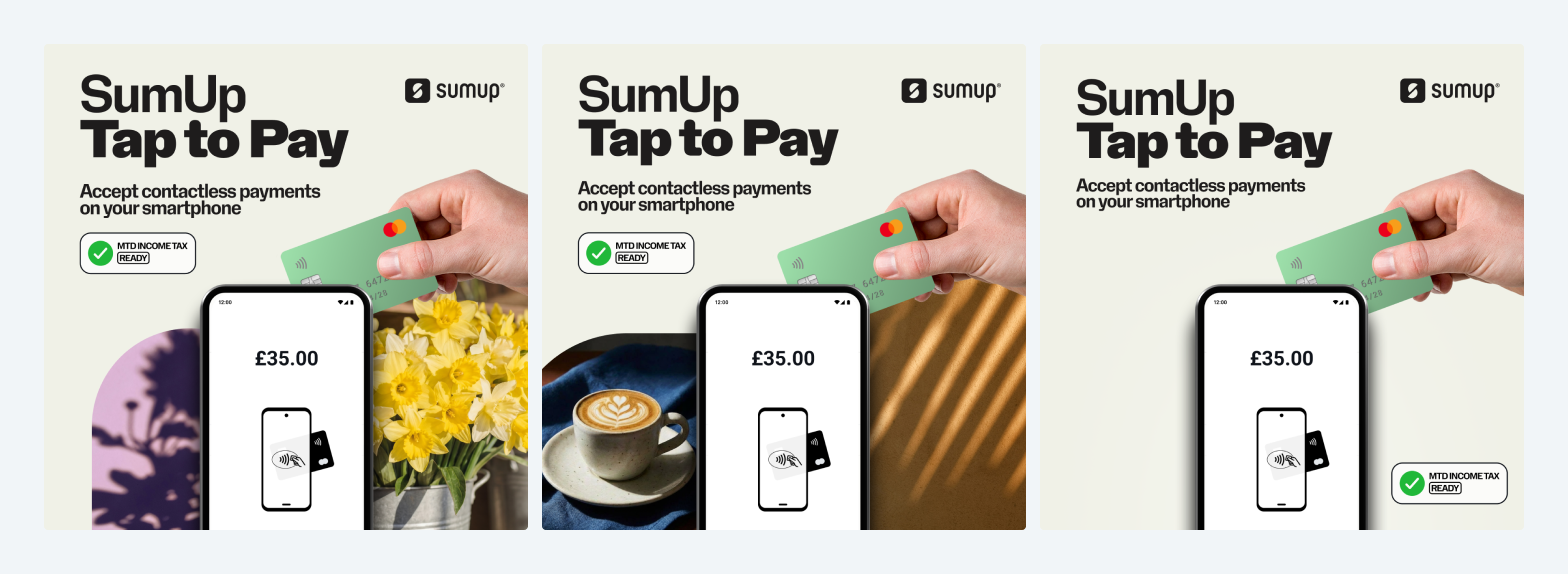
Static Assets
Downstream Conversion Optimization
Shifting optimization from installs to sign-up events gave Meta and TikTok stronger conversion signals, helping their algorithms identify higher-intent users and improve acquisition efficiency.
Portfolio Diversification
The introduction of Moloco expanded programmatic reach and reduced reliance on search and social channels, providing greater flexibility as the portfolio scaled.
Results
Over 17 months of our collaboration with SumUp, the following results were achieved:
- +409.6% increase in monthly marketing investment
- +388.8% increase in monthly sign-ups
- +297.2% increase in monthly app installs
- Only +4.3% increase in blended sign-up CPA
- Install-to-sign-up conversion improved from 15.5% to 19.1%
Our experts’ disciplined approach to channel diversification, creative optimization and performance-driven budget allocation helped SumUp scale marketing investment while keeping acquisition costs stable.

 Acquire
 Services

 Optimize