Introducing the next chapter of agentic AI in SplitMetrics: Iris, the performance optimization assistant
 Liz Skrobat
 Liz Skrobat

Iris now works the way a good teammate does: hand it a recurring task once and it delivers on schedule. Pick a template like weekly UA review or keyword movement check or turn any request into a recurring task and Iris runs it on the cadence you set. Every run ends with a decision: what changed and one concrete next step. Iris now lives on your Overview dashboard, where it suggests scheduled tasks worth setting up and it comes with actions (applying keyword recommendations, changing CPT bids, pausing and reactivating keyword or campaign statuses) that you confirm with one click.
Until now, Iris was an assistant you go to: you ask, it answers and it fixes what you approve. With scheduled tasks, Iris becomes a co-worker you delegate to, one that keeps working on your account’s performance without being prompted each time. The next part of this chapter takes it further: Iris spotting problems and opportunities on its own and eventually carrying whole jobs from start to finish.
Here’s how Iris got here and what comes next.
Iris was born in Slack. It was launched as a market research agent where UA and ASO managers could ask a question about their Apple Ads performance: who’s bidding on this keyword, how much is a competitor spending, where is their share of voice growing. Early testers took it for a spin. Anastasiia Shagaleeva, Senior UA Manager at Flo, put it this way: “What stood out to me was how easily I could get answers right in Slack via a bot.”
In March 2026, Iris was launched for Acquire customers as an AI assistant for Apple Ads and ASO, built on one idea: answers grounded in their own account data rather than a generic model’s public knowledge. It could explain why a keyword lost rank, what a competitor was doing differently, or where a custom product page was underperforming. Every insight led to a decision, but the follow-through stayed with the manager.
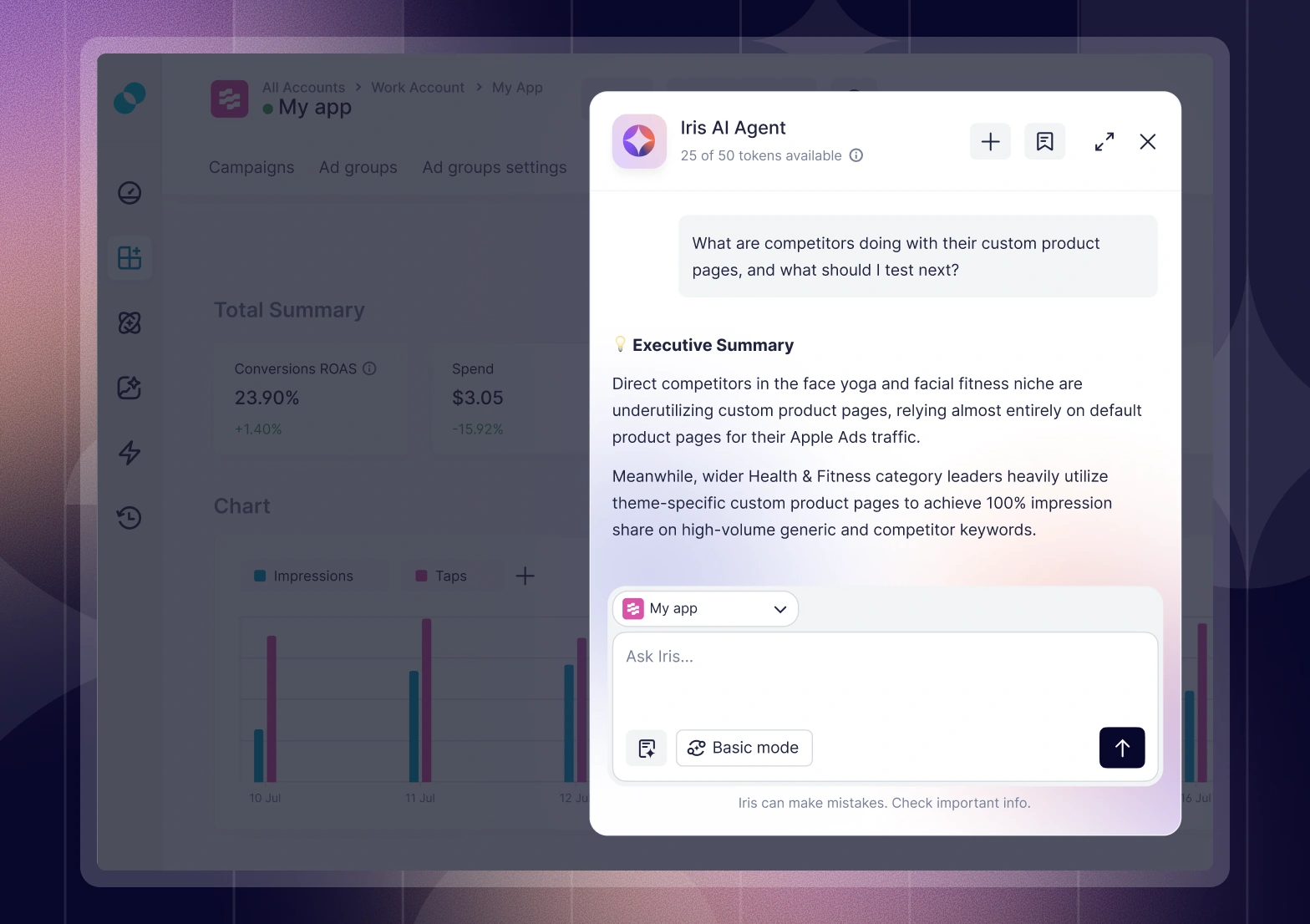
Throughout this year, we kept adding more context layers and improving Iris’s output quality.
Market data. Iris was built on SplitMetrics’ market intelligence: who bids on which keywords, how much competitors spend, where their share of voice is moving, how their keyword strategies shift. One education app grew purchases by 60% in a quarter by expanding into new keywords and markets with Iris’s competitor intelligence on spend, market and impression estimates.
Your account data. Next, Iris connected to your live account in SplitMetrics Acquire. Answers stopped being about the market in general and started being about your campaigns: why a keyword lost rank, what a competitor is doing differently against your brand terms, where performance is leaking. You can now ask Iris straight from a campaign, keyword or chart in Ads Manager and it picks up the filters and date range you’re looking at.
Campaign, ad group and CPP data. Then Iris learned to dig deeper. It started analyzing ad group targeting, budgets, dayparting, Search Match status and custom product page performance, so an answer can point at the exact ad group or page that’s costing you results, not just the campaign it sits in.
Deep Thinking. For more complex requests, like competitive analysis, market entry or Apple Ads strategy, Iris got a Deep Thinking mode. It researches in multiple passes, spots the gaps in its own answer and keeps iterating until it’s thorough.
Quality you can measure. Behind all of this sits an internal AI evaluation platform. It sends Iris a set of predefined questions and uses an LLM judge to score every answer across nine criteria, including data accuracy, insight quality and how actionable the recommendations are. Every time we update prompts or swap models, we re-run it, so we can see whether Iris got better instead of hoping it did.
Our bet from the beginning was that Iris should work as a true assistant to the UA manager, taking on part of the daily workload so targets are reached faster.
The first thing Iris learned to do was applying keyword recommendations. Then – changing CPT bids. And most recently, we handed Iris the agency to pause and reactivate delivery on your campaigns, ad groups and keywords. Next, Iris is going to start handling budgets and negative keywords.
It all comes down to automating repetitive tasks you’d normally do by hand. With Iris, fixing something across dozens of keywords or campaigns takes one click. Treat Iris as your junior employee. Ask it to find underperforming keywords and it returns an analysis with a recommended fix. You review it just like you’d review a completed task from a junior colleague: edit what Iris proposed or approve it as is, and one click later your keywords are fixed and performance is back on track.
Once you trust your junior employee well enough, you would start giving them standing repetitive jobs, like a weekly spend report or a bi-weekly keyword performance summary. This is a type of recurring manual task that usually follows a template and needs to be ready on schedule.
This is exactly the capability we’ve built into Iris next. Now, you can delegate any recurring task to Iris and it will deliver it on schedule. You can choose one of the templates — weekly UA review, monthly exec digest, competitor SOV tracker, keyword movement check — or turn any answer into a recurring task. Either way, it runs on the cadence you set, and every run ends with a decision: what changed and one concrete next step.
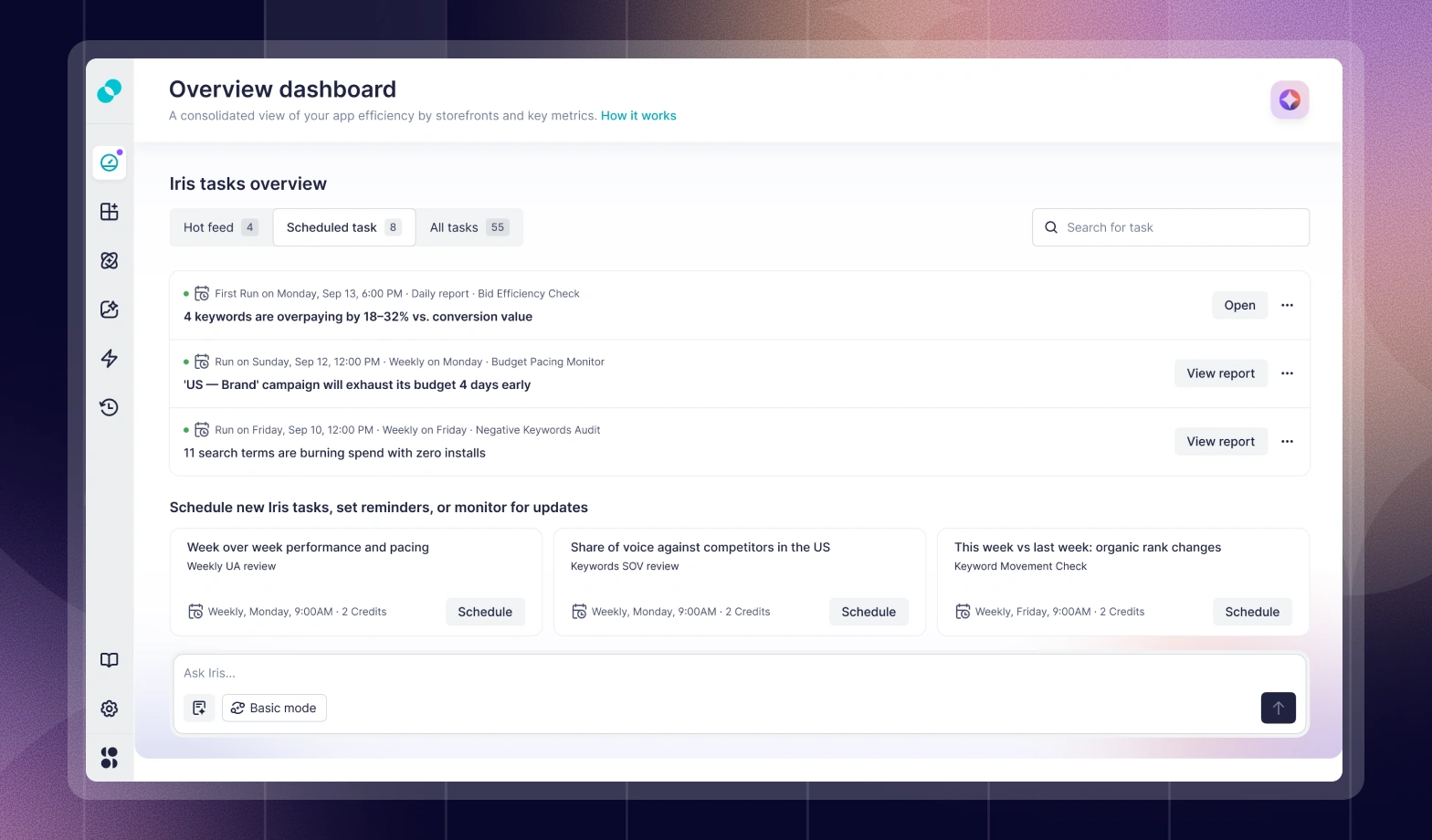
To summarize, Iris is a performance assistant you can ask, task and delegate standing work to.
Let’s think about the daily grind of the UA manager and where Iris fits there.
Monday. Instead of opening five tabs to piece together how the account did last week, you open one message. The weekly UA review is already done and ready to share with your team. That’s the standing check you set up for Iris once, ready on the schedule you’ve set.
Tuesday. A keyword that’s been carrying real spend stops converting. You ask Iris why and it traces the drop back to what actually happened: a rank slip, a seasonality shift, a competitor’s new move. That’s an answer you can trust because it’s built from your live account and market intelligence.
Wednesday. A competitor swaps the custom product page they’re running against your brand terms. You don’t catch it three weeks later wondering why CVR dipped, because you asked Iris to check competitor activity daily and flag what’s changing. Iris surfaced it and suggested a fix: pause the keyword that’s stopped returning on its spend, reactivate one that’s earned another shot. You approve once and it applies everywhere the fix is needed.
Thursday. A bid needs adjusting across two dozen keywords after the target metric performance shift. One approval and it’s done everywhere at once.
Last Friday of the month, instead of blocking an afternoon to pull spend, conversions and trend lines across every storefront by hand, the monthly exec digest is already built and waiting.
Every action Iris takes, whether you requested it or Iris spotted the opportunity first, follows the same rules:
You’re still the one deciding what to do about what Iris finds. What changes is how much time you save searching versus actually acting on the insights Iris surfaced.
Iris runs on a unified data layer covering 2M+ apps, 70 storefronts and 3M+ keywords. Bid recommendations are powered by SplitMetrics’ predictive bidding models, reassessing each keyword roughly 30 times a month, with 99% accuracy across more than 5,000 processed queries.
Today, Iris acts on the tasks you set up and the questions you ask. The next milestone is Iris monitoring your account around the clock and surfacing what needs attention before you think to look.
Iris that keeps watch. In the background, Iris keeps an eye on your performance and proactive spots what’s capping performance: an ad group that has quietly stopped performing, a keyword sitting underbid while a competitor captures volume it should be winning.
Iris that learns how you work. Ask the same question three weeks in a row and Iris turns it into a recurring task. A metric slips below the threshold you care about and Iris comes to you with the fix already prepared.
Whole jobs, start to finish. Tell Iris to launch your app in a new market. It researches the keywords, pulls in creatives from Lyra, sets up the campaign and stops at a final approval, inside the budget and bid limits you’ve set.
Every one of these still ends the way Iris’s work does today: with a proposal you approve. What changes is how early you find out something matters and how much of the work is already done when you do.
Iris, including scheduled tasks and direct actions, is available now to SplitMetrics Acquire customers, and every account comes with 20 free Iris credits a month to put it to work. If you’re already on Acquire, ask your account manager for a quick demo.
If you’re evaluating tools for scaling your Apple Ads performance, let us show you how SplitMetrics Acquire helps performance teams achieve +25% revenue growth.